2023 April Hot Audit News
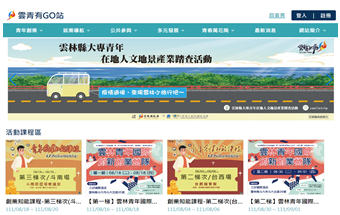

The Yunlin County Government has implemented the Youth Entrepreneurship Grant Program to encourage young people to start businesses in their hometowns and promote economic development. 11 cases have been approved and NT$3.6 million in subsidies has been provided in the program in 2022. The Yunlin County Government announced the acceptance of the application in 2023, effectively providing substantial assistance to the youth.
The Yunlin County Audit Office pointed out that the Yunlin County Government changed the name of the Labor Department to "Labor and Youth Affairs Development Department" in December 2020 in order to enhance the capacity and quality of youth affairs development and business promotion. The Youth Development Division was established to provide integrated services by combining industry, government and academia on 1 March 2021. The Division offers courses related to entrepreneurship cultivation to help young people start their own businesses.
However, the Yunlin County Audit Office found in November 2021 that the Yunlin County Government had drafted an implementation plan and the establishment guideline for the Yunlin County Youth Entrepreneurship Grant Program in 2020. Due to budget and other issues, the implementation plan and the establishment guideline eventually were not been issued for implementation. In the meantime, the Labor and Youth Affairs Development Division, the Agriculture Division, the Culture and Tourism Division, the Planning Division, and the Urban and Rural Development Division have been promoting various programs related to youth creation (employment) In order to promote industrial and commercial development and the return of young talents. However, the relevant information and resources are not properly integrated with the user's point of view. The Yunlin County Audit Office notified the Yunlin County Government to undertake corrective actions on 15 January 2022.
The Yunlin County Audit Office stated that the Yunlin County Government has released the implementation guidelines for the Yunlin County Youth Entrepreneurship Grant Program and the establishment guidelines for the Yunlin County Youth Entrepreneurship Grant Management Committee on 26 January 2022. In addition, the "Yun Qing You GO Station" platform was launched in June 2022 to integrate various youth entrepreneurship information and training programs. Subsequently, a donation of NT$100 million from private enterprises was funded the aforementioned Entrepreneurship Grant Program. The first round of applications were accepted between August to September in 2022. By the end of 2022, 11 young people had been approved for grants, with a total amount of NT$3.59 million. Applications have been accepted from 16 January to 15 March 2023, providing entrepreneurial counseling and funding to enhance the success rate of youth entrepreneurship.
The Taipei City Government's Public Works Department's Park and Street Lights Project Management Office (referred to as the "Street Lights Office") carried out the integrated installation project of smart street lights in the redevelopment areas in 2019. According to the Taipei City Audit Division’s audit finding, 79 existing smart street lights had been replaced repeatedly. After the Taipei City Audit Division informed, the Street Lights Office has urged the contractor to conduct remedial actions. In addition, five specific regulations for the street light project have been revised, and a check and punishment mechanism has been established to ensure the expected benefits of public works can be achieved.
The Taipei City Audit Division pointed out that the Park Lamp Project Management Office of the Public Works Department of the Taipei City Government (referred to as the "Park Lamp Office") handled the 2019 Redesign Area Smart Street Light Installation project (the amount of contract is over NT$ 63.58 million) to promote the installation of smart street lights.
According to the project requirements, the contractor for the project was required to install 2,465 smart lighting control devices with remote monitoring, flashing, brightness adjustment, and automatic fault reporting functions in the Neihu Science Park and Xinyi Plan areas.
However, the Taipei City Audit Division found in December 2021 that the design layout of the turn-key contractor installed 79 streetlights that had been equipped with smart lighting control devices to add controllers. Due to the fact that the Public Lighting Office did not connect all the information of the smart streetlights to the streetlight management platform, the Office did not recognize that. In addition, the supervision contractor did not implement effective supervision during the construction period, resulting in the unnecessary replacement of the 79 existing smart streetlights. The relevant inspection mechanism is not exhaustive. The Taipei City Audit Division notified the Public Lighting Office to improve the situation in January 2022.
The Taipei City Audit Division stated that the Public Lighting Office has instructed the turn-key contractor to reinstall 79 smart street light controllers on the Zhumei Expressway in July 2022 and penalized the turnkey contractor and supervising contractor with punitive breach of contract fines. In addition, all smart street lights have been controlled under the management platform. As at the end of February 2023, the Public Lighting Office has completed the revision of specific specifications for street light projects, the package project requirements, the planning, design and supervision technical service case requirements, the supervision plan, and the quality plan templates, etc. In addition, they have added inspection and penalty regulations for the installation of smart street lights to achieve the expected benefits of public constructions.
The Health Bureau of Penghu County Government (hereinafter referred to as the Health Bureau") handled the work of distributing rewards to staff. After auditing by the Penghu County Audit Office, it was found that some public health centers had distributed rewards to non-permanent staff. However, the Bureau had not set clear criteria for the distribution of rewards, and there were issues of unfairness in the distribution ratio. The Penghu County Audit Office notified the Health Bureau to improve the situation. Then the Health Bureau has established criteria for the distribution of rewards for staff at its affiliated public health centers in order to enhance regulations related to the distribution of rewards.
The Penghu County Audit Office pointed out that the Health Bureau referred to the guidelines on payment of rewards for staff of the local administrative chronic disease centers, public health center and district health centers, then set up the principles and evaluation criteria for the distribution of rewards for staff at the chronic disease centers and the public health centers under the Penghu County Medical Operations Fund on 26 February 2013. The Health Bureau has requested that each health center issues rewards to its staff to improve the quality of medical services based on the guidelines mentioned above.
However, The Penghu County Aaudit Office found in August 2022 that some public health centers issued rewards to non-permanent employees without clear regulations on the recipients of such rewards. Moreover, there was no connection between the evaluation criteria and the work duties of non-permanent employees. In addition, there were no rules for the distribution of rewards to doctors and non-doctor staff, causing some doctors and non-doctor staff to receive different proportions of rewards, which resulted in unfairness. Therefore, The Penghu County Audit Office notified the Health Bureau in October 2022 to seek improvements in the reward distribution system.
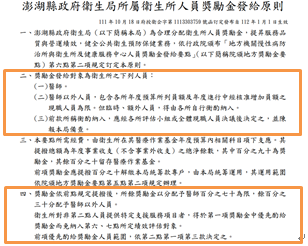
The Audit Office stated that, after monitoring the improvement, the Health Bureau has reviewed the guidelines mentioned above and set up the principles for awarding bonuses to health bureau personnel of the Penghu County Government on 18 October 2022, which established standards for the distribution of rewards, performance evaluations, and allocation principles. This allowed for the reasonable distribution of rewards to staff, energized morale, and improved service quality and operational performance.